Sunday, May 18, 2014

Who is Han Solo?


The Millennium Falcon is a spaceship piloted by Han Solo and his best friend, Chewbacca. I call Chewbacca Han’s “best friend,” because he’s not just a counterpart or pet – they’re close, like family. And the Millennium Falcon isn’t just a hollow ship – it’s a house, home, mode of transportation, and a central part of Han and Chewy’s story. The Falcon is a character and a central piece of Han’s identity. He knows its bugs, how it works, and how to keep it going. The Falcon is an extension of Han and a pivotal piece of Han and Chewy’s friendship. Without the Millennium Falcon, who is Han Solo? Maybe more simply: Who is Han Solo?

Floating around space on a ship that most regard as space junk with a furry critter and a finicky engine, Han Solo is an intergalactic vagabond. He’s a guy with a single plan – making it day to day without much trouble. He has given up on making it big, seeking enlightenment, and maybe even women. Princess Leia, many years his junior, doesn’t really impress him much. He’s rough around the edges, maybe a little sleazy, and makes enemies rather easily. He makes friends just as easily.

But women love Han. Even if they don’t want to. Princess Leia, despite her best efforts, can’t resist the free-natured, care-free, scruffy (yet handsome) looks of Han Solo. Neither can the female fans of Han Solo. But, why? Who is Han Solo?

Han Solo is a loser. He’s a guy living in a flying Winnebago. He doesn’t have a job. He doesn’t pay rent. He just buys spaceship gas and doesn’t even fill up the tank all the way. Han Solo doesn’t change his clothes. He lives with a giant dog/cat-like creature and picks up intergalactic hitchhikers. He doesn’t even clean his roaming house, which is actually more of a glorified moving van – it’s a cargo ship. Han Solo doesn’t even pay his debts, which means he must have a pretty horrible credit rating. But women love Han Solo.

Of all the things Han Solo is (or perhaps more importantly, is not), he is adventurous. He is care free. He’s daring, has swagger, and tries to not care for anyone but himself. He knows Chewbacca can take care of himself, so doesn’t pay any mind to watching out for him. He knows his vehicle so well, his lifestyle works. If there’s another thing that Han Solo is, he’s smart. He’s very smart.

Han pilots an old ship that most people consider to be garbage. He has no debt on his vehicle, which is also his house. He has no dependents. And he can fix everything on his ship by himself. Of course Princess Leia doesn’t pay any mind to these details, only Han’s swagger and his insolent attitude toward her sense of ego and political aspirations. Han Solo is independent. He lives his life the way he wants to, doesn’t need much, and seems to generally enjoy living below the radar.

Being Han Solo in today’s world is difficult. The Empire is everywhere. There are no far away planets to escape to. Debts aren’t so easily resolved as with a blaster. And not every guy looks like Harrison Ford. But who is Han Solo, if not a guy with a great life, just the right amount of companionship, freedom to roam, and the ability to do it all with his own hands? Han Solo is a guy living under the radar, on the frontier, and without worldly needs – and he’s doing it in a flying Winnebago.

Han Solo has the life and he gets the girl. Everybody loves Han Solo.

Sunday, April 27, 2014

The Problem with Tiny Houses


The “Tiny House Movement” is great, but it’s also a failure. It’s great that people are starting to think outside the imprisoning mortgage and rent system, but the guise of environmental-mindedness needs to be questioned. The total dollar savings over a foundation house is unquestionable, but looking more closely, not only is the cost “savings” questionable, but the utility vs. cost isn’t great.

The tiny house movement appears to be as rooted in environmental motives as it is in protest of conventional economic norms. The reduced size of the houses is supposed to be less resource intensive in construction materials required, as well as less energy intensive due to less volume of space to heat, clean, and maintain. For many of those savings, there is a true savings to be had. But to what end and is it really saving anything?

The reason for the environmental question is that the tiny house movement is really just creating new housing spaces. It’s not replacing, repurposing, or improving current housing spaces; it’s creating new demand for building products and creating more housing spaces. From a pop-enviro-culture perspective, the creation of smaller, more efficient spaces is great. But it’s NOT great to be creating new demand for new building products, flatbed trailers, etc, only to create MORE housing spaces. The creation of these spaces either leads to more room being made for others to come into empty housing spaces and/or it leads to the abandonment of pre-existing housing areas. In essence, the tiny house movement is just a new form of consumption and a new pathway for population growth, which is in conflict with the core of current problems that environmentalism is concerned with.

Tiny houses are often recognized for being a better dollar savings over a conventional home. But are they really? Tiny houses are often 100-200 square feet, sometimes a little more. The costs I frequently see on the internet are between $18,000 and $35,000 for construction materials. If we look at cost per square foot, that’s $90-$350/square foot at the extremes of those numbers. A $200,000 house with 2,000 square feet is $100/square foot. The tiny house only solves one problem: Total cost. Dollars per square foot, tiny houses cost as much or more than real houses.

That’s why the tiny house movement needs to move toward recognizing RV dwelling as part of the tiny house movement. RV’s over 10 years old have lost so much of their value, few are worth very much. My Winnebago Brave was 14 years old when I bought it and had lost over 80% of its original value. My 200 square foot [RV] tiny house cost only $50/square foot, which is a tremendous savings over the cost of building a new structure and it was ready to go the moment I purchased it. Modern RV’s are well-insulated, the electrical systems are well designed, and are fully self-contained rolling homes.

RV’s make even better tiny houses than tiny houses, in part because they have lost their value due to high gas prices. Not too many people are wanting to buy gas for these beasts that get 4-8 MPG. As a tiny house, one can park it and move it only as-needed. I only move mine in the summer around town, then I will move it to another location once I locate employment. My gas costs are almost non-existent. I have put 300 miles on my Winnebago since I bought it almost two years ago.

There are fields upon fields of RV’s, rotting, waiting to be sold. The RV is a preposterous thing to begin with, but with gas prices over $3/gallon, they’re unsustainable for almost anyone to use recreationally. Which is one reason the tiny house movement is preposterous. There are fields of mobile, manufactured, tiny homes that have almost no value and represent a huge potential savings over the construction of a new structure to live in. These rolling, self-contained, pre-made and largely abandoned homes are a much better answer to the problems that tiny-housers are trying to solve. The most environmentally friendly thing one can do is to repurpose something that is unused or underutilized, rather than construction of new places and the creation of new demand for building products. Time for the tiny house movement to start looking at repurposing rather than just creating new construction. Tiny houses are just RV’s made with conventional housing products, which are heavy and require a big, powerful truck to haul them. Tiny houses solve only one problem, but they create all new ones.

Sunday, April 13, 2014

Walking A Fine Line


Living in an RV, there’s a fine line that exists between trashy and adventurous. I only suggest this based on the stereotypes I run into and the ways some people seem to think about such a living arrangement. Whenever someone builds a “tiny house” on a flatbed trailer, the internet appears to stand up in applause. Often costing upwards of $30-$40 thousand dollars, tiny housers are often lauded as some kind of hero of the people for going to extremes to escape. When I tell people that I’m “doing the tiny house thing by repurposing a motorhome,” I get varied responses from “wow, that’s really cool!” to “yikes, living on the edge, huh?” The core of the response appears to be rooted in how each person understands financial freedom, responsibility, and the housing system.

Dodging the line between trashy and adventurous isn’t really a problem for me – as a graduate student with a history of successful career choices and an undeniably robust garage of adventure tools, the line itself only exists when meeting people and having to disprove their stereotype. The effect is an uphill battle every time I meet someone and an almost ubiquitous cultural disconnect on why such a lifestyle would have been arrived at in the first place.

Thinking about the cultural norms at work here, I must point out that I am amplifying a minority of reactions in order to make sense of it, but the minority of reactions end up having power. The way some people assume trashiness or dismal poverty can be almost oppressive. Words and reactions to my lifestyle, though infrequent, leave me sometimes feeling the need to prove myself more than I should have to. The reason this reaction comes about is that I find that those who are judgmental or skeptical are often carriers of pernicious stereotypes and are totally unaware of their place in a system that is there to keep them as poor as possible for as long as possible.

Hashing this out is almost ridiculous because I’m talking only about a tiny fraction of the reactions I encounter and the likely presence of discrete reactions that I do not directly encounter. Nevertheless, the presence of shortsightedness and *-isms is an ugly reality.

The reason I find this so fascinating is that dissenters are often in a far worse position than I am, financially, and with their life potentials. I own the roof over my head outright, I own a [real] house that I rent out, and my living expenses are a fraction of even the cheapest apartments. As soon as I start working again, I get to keep an unfair portion of my wages instead of paying for some slumlord’s luxury vacation or fancy car. I can rent an apartment, just like the [imaginary] dissenters, tomorrow and then have an RV to park in some cool place for the weekends.

Though this may be an imaginary problem, I anticipate the presence of such dissent, perhaps in those who know of me but don’t know me. And I must suggest that dissent is based upon a total misunderstanding of the financial system that I have created, the purpose of the system, and the flexibility of the system. This life project is based upon the idea that I am still young enough to unhinge my life, so the next phase can be rooted in security and lack of debt. But it’s hard to communicate these things to those who have never thought about how criminal it is to pay a landlord a “market price” for an apartment or pay endless interest on a home loan. While we will all be subject to these forces for our entire lives (in the middle and lower classes, at least), even in my crazy little situation, some don’t seem to even comprehend why someone would want to minimize their exposure to such a system by going rogue. Why not just pay for an apartment every month, right? Maybe I shouldn’t be so intent on flipping the system, but I am yet unchained and domesticated to the point that I can do this, do it well, and come out ahead. At least that’s the way I see it.

Monday, April 7, 2014

Tiny House Highlight: An Amazing Design

Not really related to my RV situation, but I thought of a design for a house like this a while back and then saw a live version of it:

http://tinyhouseswoon.com/escape-cabin/


I will have one someday.

Sunday, March 30, 2014

Spring and Summer are Coming

I can't wait for spring and summer. Who can't, right? But I can't wait for reasons that are quite different from the ones cited most.

There is nothing quite as peaceful as living in a Winnebago during the summer months. In my location, clouds are lower to the ground and thunderstorms are almost a daily occurrence, preceded and followed by sun showers and clear skies.

What that means for me is the sound of raindrops hitting a thin roof, creating an extremely soothing sound that rocks the endorphins and can put you to sleep in minutes.

The other thing it means is windows open all day, every day. In a house, it often takes a bit for the smells of the outdoors to reach the center of the house. Not in a Winnebago. The smell of rain hits like you were standing outside in the rain.

Spring and summer mean no more worrying about heating, snow, ice, and energy bills. Instead, it means warm days, open air, the sound of rain on a thin roof, cool nights, and the thrill of seamless integration with the elements.

Summer is almost here.

Monday, March 24, 2014

Living in a Winnebago: An Introduction for the Unfamiliar

My lifestyle is sometimes hard to explain. I say "I live in a Winnebago" and many common images come to mind for those who just meet me. One common one is that they picture me parked in an empty field outside of town in a 1970's vintage van or dilapidated RV, yellowing and disintegrating. Couldn't be further from the truth. If you've met me, you know that you never would have guessed my lifestyle from my appearance. So, for those new to this, here are some explanations to jump-start your understanding of my lifestyle.

1. It's a tiny house

If you've heard of the tiny house movement, there is an entire movement about living in homes that can be built quickly and within one's means. This movement is largely in contrast and reaction to the bursting of the housing bubble years ago and excessive home prices that require huge, long-term mortgages in order to attain. The tiny house movement is a group of people moving into spaces that allow them to live simply and without mortgages that lock a person down for upwards of 30 years (more if refinancing happens). It is also a reaction to rent markets and landlords. It's a way to own a home, but to actually own it -- not to lease it or mortgage it.

2. It's entirely mobile

When you hear "mobile home" or "trailer," mobility is implied, but trailers, like you would see in a trailer park, aren't really that mobile. They're not even a good deal or way to live. Not only does the structure lose value, but the lot rents, even in a shitty town often start around $400/mo. So, my RV is the answer to that. It's entirely mobile. And I wanted it that way. RV lot rents are month-to-month or even day-to-day leases. When I'm ready to leave my college town, I call my landlord and tell them I'm pulling anchor tomorrow, and as soon as tomorrow comes, my lease is terminated without any penalties. My lot rent includes all utilities, except propane, and is significantly less than that of the trailer lot rents -- perhaps in large part because I'm taking up 26'x8', rather than 20'x40' on their property. If I get a job in Bozeman, MT tomorrow, I unplug my house and drive it to Bozeman, MT.

3. No chains

There's a common misconception that young people are free. Well, they're kinda free. But most are locked into year-long leases. They are also subject to market shifts in rent costs on apartments. An apartment in Laramie, Wyoming that rents for $400/mo would rent for $1,500/mo in Boulder, Colorado. RV lot rents are not as volatile, in large part because there aren't many people year-around dwelling in tiny houses or RV's, so there's not a huge market for it.

4. Living is vastly simpler

Okay, it's not for everyone, but some things have become simpler. Namely, instead of having 500 square feet (a tiny apartment) to clean, I have 200. I can vacuum, sweep, and mop my entire house in 20 minutes. Who wants to spend time cleaning a 500, 1000, 2000, or larger house as a single, young person? There are some contrasts to this, like all the things I had to invent that make this lifestyle both possible, but safe and comfortable. Once those inventions were in place, everything else became simple.

5. It's financially responsible

I have financial goals. I didn't take this project on because I'm a lazy slob. I took it on because I knew I was functional and durable enough to do this and do it right. I realized the importance of financial independence and freedom and realized that the difference between the rich and the poor is that the rich own their things outright, the poor pay huge interest rates that allow the rich to own their things outright. Not being rich myself, I realized that I had to find a lifestyle that was entirely financially sustainable and this was it for me. Did I find it? Absolutely. My financial plan includes getting a job, paying off all of my student loans, and getting a significant down payment for another house.

6. It's fun

Most people's living spaces are apartments that never seem to feel like or become "home." My space is distinctly a home space and it is my home space. It's also incredibly fun. My summers are spent rolling between friend's houses and being able to go anywhere I want without much notice or thought. How many houses have a steering wheel? Not very many, but I think more should.

7. It's bizarre (in a good way)

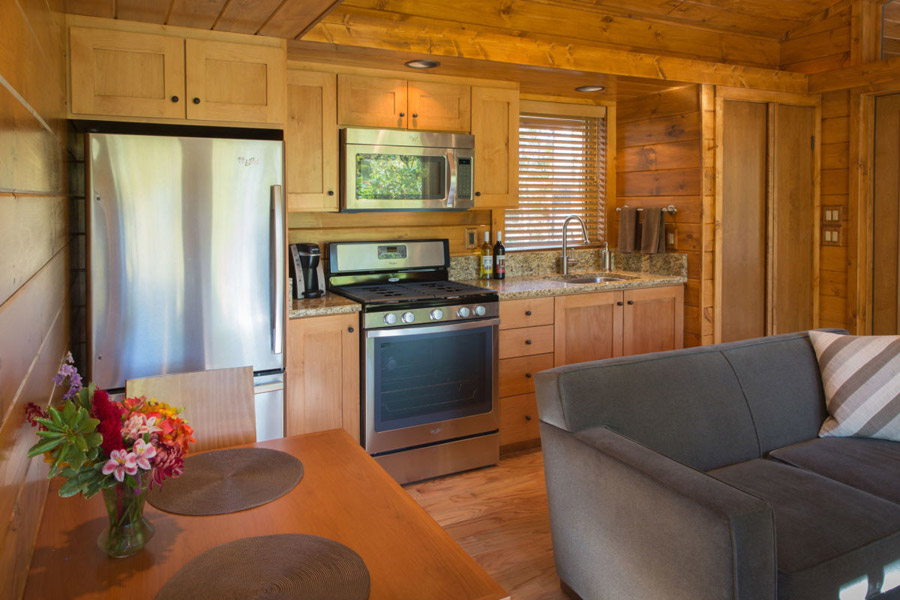
Some people think it's weird to live in an RV. It is -- but in an outside-the-box sort of way. Instead of dealing with shady landlords, looking at bunches of crappy apartments, and always borrowing my home space, my home space is mine. And it's all mine. Not many can say that, not even those who "own" homes with mortgages. So, is it weird to live in an RV? Maybe, if you haven't thought much about how weird it is that banks own our houses or that profiteering landlords own our apartments. I have all the same amenities as an apartment: Stove, oven, microwave, TV, stereo, toilet, shower, sink, refrigerator, freezer....

8. It's safe

Most people in apartments are at the mercy of working utilities. Not me. I have a 4,000 Watt generator (enough to run more than 60 60Watt lightbulbs at once) and backup batteries, a water tank, and waste tanks. When floods happen, people in houses abandon their houses. When floods happen to me, I drive my house to higher ground. When a furnace goes out in a house, people in apartments wait for the landlord. When the furnace goes out in my house, I turn on a couple small electric heaters and repair the furnace. Most reactions to my living situation include concern and fear for my wellbeing -- the truth is, everyone else is in bigger danger than I am, pretty much at all times. In an apartment building, neighbors can start fires that can burn the entire structure down. In my RV, I am the only one who can burn the place down.

9. It's part of a great future

Combining multiple items above, my next steps are flexible and fun. My plan is to live in the RV for one more year while I pay off a more than a decade's worth of student debt going back to when I was 18 years old, then sack a down payment for another house. I have to admit, there's a relationship element to this that makes the plan highly flexible: If I don't happen to be in a relationship at that time that warrants cohabitation, I intend to stay in the RV either until I am or until I have enough cash to pay for a house outright. Either way, the next phase for the RV after that point is the fun and great part. It becomes my cabin. Not just any cabin, but a cabin I can put in any town I like that has RV lots. What that means is that I get to drive out to my rolling cabin during summer weekends and have a base to shower and play from. It's an extra expense, but it's better than the 'bago rotting in an RV lot. And it means I have a new cabin property every year until the 'bago becomes uninhabitable. Who ever would have thunk of such a plan?

Anyway, that's a rough intro to the RV situation. Probably not a list of items that most would think of, but that's because of ridiculous cultural expectations for how to live and stereotypes created in media accounts. So few realize or can comprehend what I am doing, but as those who know me understand well, I'm not doing this because I couldn't do well at apartment living -- it's because so few could make this work as well as I do. It's free and it's financially responsible. But it's not for everyone.

Wednesday, March 19, 2014

Developing New Habits of Thought and New Ways of Living


I have been living in my Winnebago for a year and a half now. The things I’ve learned and the problems I’ve solved have been an incredibly fun journey. From rolling into my college town in my recently purchased ‘bago, to making my own RV skirt system in a panic while starting grad school, to weathering my first and second winters in a very harsh environment, or parking in front of friends’ houses all summer instead of paying lot rent, or even having to rebuild my furnace in sub-zero temperatures in the dead of winter, the adventure has been fun. I realize that many might not find much of that fun, but it’s fun in a different way – it’s the creation of an adventure in daily life. It’s also an entirely new connection to wilderness.

Living in the Winnebago, I have developed new habits of mind. Working quickly, but precisely. Planning for every eventuality and planning for the unknown. Being resourceful and self-sufficient. I had these skills before, but this lifestyle has led to an amplification of these skills. The threat of the elements is powerful in the place I live, so responsibility and precision are critical in all actions. Frozen pipes, flooding from frozen pipes, or malfunctioning heating systems are just an impossibility in a place that can hit negative 40 in winter.

For those in houses or apartments, isolation from the elements is essentially guaranteed. Furnaces are reliable, reliable electricity is always on hand, heating gas comes from a pipe in the ground and not a tank. The RV is just a little closer to the very environment that we isolate and insulate ourselves from in order to survive better for longer. Rather than 4-6” thick walls with fiberglass insulation, the walls are 1.5” thick Styrofoam. The vehicle is intended for 1.5 season use in mild climates, not year-around use in a place that is winter for over half the year.

Wilderness is a legal designation for a place. But the legal designation is born from a place in the collective consciousness of westerners that is different from the human or domestic space. Whether that line can ever be crossed or whether that line exists at all is a question worth pondering. Pertaining to life in a Winnebago, I am closer to whatever that wilderness might be on a daily basis only because of the fine line that exists between the risk of failure and the elements that would normally threaten life.

Am I at risk? Not really. Am I closer to “wilderness”? Maybe. But it’s not the wilderness that is designated legally. The wilderness I end up closer to is cold temperatures, frozen pipes, and a house that is almost an inside-out version of a foundation house. My water pipe is outside in open air, my sewer line hovers above the ground, and my picture windows are a windshield that is now insulated only by creatively repurposed quilts that dramatically change the r-value of the single-pane glass windshield.

I now live as naturally in a land ship as anyone else does in a brick and mortar house. It has created a new habit of thought about what a home is, what wilderness is, the role of adventure in our daily lives, and a deep understanding and respect for the fragility of life. Perhaps most of all, it has led to an understanding of the inextricable reliance on technology and energy for life in just about any place north or south of the tropics. Technology is as much a part of the human as it is the wilderness in these spaces because we could not survive here in the way we do without it. Even in a Winnebago, I am insulated from primal nature through technology and energy – I am only inches closer to whatever that environment is by choice and new ways of living that provide me the privilege to pay rent at-will and to go anywhere I want to live at a moment’s notice.