Friday, November 14, 2014

A New Propane Strategy


RV furnaces, water heaters, stoves, and even refrigerators run on propane. My ’98 Winnebago Brave has a built-in tank that fills to about 15 gallons, which is enough to meet my needs from the 1st of May until the 1st of November. That’s fantastic, but needs in the winter months change dramatically. At my last more permanent location, I had a 120 gallon tank delivered, which served my needs for the better part of the winter. Since I am so transient with work and location right now, I want to be anchored, but not –too- anchored. Being anchored, but not too anchored requires a different strategy for propane.

At my last location, I had a 120 gallon tank delivered, which was great for long periods. However, it cost $100 for delivery and $100 for removal. That’s $200 every time I move, which isn’t sustainable. In my new location, I got numerous quotes and all came in around $240 for the same service. Some places even charge a yearly tank rent of around $70, so the cost of having a tank present is costly. Making things worse, every propane delivery to a rented tank comes with a $18 haz-mat fee.

To solve some of these problems, I decided to create all new ones this year. Since the cost of moving is so high, the price of propane delivery adds up, and the price of propane is ridiculous this year, I am changing my energy strategy. First, instead of heating the house primarily with propane, I will be using electric heaters. Electricity is $0.15/kilowatt-hour at my park, whereas propane is currently around $3/gallon. Second, I will be using the install/removal fees as my budget to buy my own tanks.

The $0.15/kWh vs. $3/gallon figure above is almost useless. Except that on the coldest days, I will use approximately 20 kWh for the 24 hour period, which is $3/day for all electricity needs. On that same day, I would use about 1.5 gallons of propane, which is $4.50. Though these figures are preposterous since I’m heating a breadbox, they’re accurate.

My new strategy comes with some pitfalls. I now have to get my personal propane tanks filled on my own, which means transporting them in my car. I had to buy a bunch of brass knickknacks and hoses to connect the tanks to my RV. Yeah, they don’t just screw on and poof, done. Nothing with RV’s is. So, I had to choose tanks that I could lift, but that wouldn’t run out too quickly. The biggest tank I am comfortable transporting and moving on my own is a 40# tank. The “#” there is “pound,” but is not a direct indicator of weight. For instance, the 40# tank holds 9.4 gallons and weighs 70 pounds (Lbs) when full.

So, propane and gas lines are ridiculously convoluted. It isn’t possible to just go to the hardware store and buy a connection kit. Nope. The first step is figuring out where you want to hook the tank into the RV; before or after the vehicle’s regulator. Well, let me tell you; this isn’t an easy choice to make.

To make a long story short, I chose to connect the new tank directly to the RV’s main propane inlet and to regulate pressure at the new tank. What this required was figuring out what kind and size of fitting the RV inlet was. It ended up being a ½” flare fitting. Easy, right? Nope.

With propane fittings, you have to know thread direction (some are reversed), type of connection (flare or pipe) and you have to know these details about every single junction and what types of fittings are possible to obtain for fitting to the next piece. Since I knew what the inlet was, I built from there. Here’s the list of parts I ended up with to attach the new tank to the ‘bago:

RV Inlet: ½” normal-thread male flare
NEW PARTS
Swivel Union (1/2” flare nut to 3/8” flare nut)
Flare to Pipe-Thread Adapter (3/8” normal-thread male flare to 3/8” normal-thread male pipe-thread)
5’ Hose Assembly (3/8” normal-thread female pipe-thread to 3/8” normal-thread male pipe-thread)
Pressure Regulator with ACME Nut (3/8” normal-thread female pipe-thread)
40#, 9.4 gallon propane tank with ACME male connector/valve

Doesn’t sound that bad. It’s not. But I found the simplest solution possible for connecting my own propane tank to the ‘bago. Regrettably, it has taken me too much time and too many trips to the hardware store to finally figure it all out. Many hardware stores don’t have all the connections needed to make this possible.

Many hardware store trips, questions, and frustrations later, I’m up and running. I’m now more mobile than ever before. What’s the value of that? Well, I’m not sure. But since I don’t have a permanent job, it seems that minimizing these $240 propane tank moves might be worth it. In the end, I’ll have a couple nifty 40# propane tanks that will act as year-long barbeque tanks at my future permanent home. The $240 I would have spent to have a tank delivered and removed just turned into a one-time cost of about $100, $170 if I want a second big tank, and I never have to pay that again if I don’t want to. In the last two years, I have lost $480 to propane tank delivery and removal and in total, $600 to propane tank machinations. I’ve learned my lesson. I just wish I learned it sooner.

Tuesday, November 11, 2014

A Brief 2 Year Review

Living in an RV for just over two years now sounds nuts. The reason it sounds nuts is because it is. The RV is 26x8.5 feet; it's a rolling house with a 221 square foot footprint. The smallest apartment I have ever seen is just under 400 square feet. The only common American living spaces smaller than my domicile are dorm rooms, but even then, the dorm room doesn't house bathroom, kitchen, bedroom, and the moving truck. After two  years in my RV, I have learned a lot, lived even more, and have changed so many of my perspectives.

One of the things I have learned by living in an RV is that RV's are the most fragile, non-durable, and most poorly designed devices in existence. There is a reason a $100,000 RV sells for only $10,000 only 10-15 years later. The reason is that all of the systems will be degraded, in need of repair, and will be expensive to fix. I have had to repair the furnace, water heater, refrigerator, waste tank valves, toilet, and electrical systems. Sure, I've been full-timing in the beast for two years, but it was barely used for the first 12 years of its life. Being handy and all-seasons-durable has been a requirement of full-timing in an RV.

Another thing I have learned about RV'ing full time is that it is not as cheap as one might think. Rents are slightly cheaper than apartment dwelling and there are no leases involved. That's great and worth its weight in gold as a post-graduate graduate looking for work and doing contract work. But rent is still needed and it is still based on the value of the place being rented from. If an RV park is in a desirable location, the rent will be based upon the economic potential of the park to sell its land to a developer to put apartments on. What that means is that an RV park will rent you a parking space with a water spigot, open sewer hole, and an outdoor electrical plug for about the price of a super-cheap apartment. In a short: RV rent is a colossal ripoff.

Before I moved into the RV, I believed that owning is always better than renting. Bullshit. As a landlord on the side, I can tell you that owning is almost always the ripoff. As a homeowner renting out my property, I can tell you that my tenants have it great; They pay exactly what I pay in mortgage, insurance, and HOA, yet they don't have to worry at all when something goes wrong. If the water heater breaks, their cost is a phone call and a little time; My cost is a new water heater, time, installation, and removal of the water heater (aka. $1,000 down the shitter). Sure, they don't get the deed to the property in 30  years, but chances are pretty good that I won't either. Owning is better than renting? Nope. Not if time, flexibility, and lack of responsibility are qualities of life one wants.

Another important lesson that has come out of RV-dwelling is that nothing in America is free. I mean "free" and free and free. Nothing. The homeless of this country are frowned and crapped upon for their situation. "Why not get a job and an apartment," we all say. Well, here's the thing, you first have to get the job, then keep it without having the apartment. That's hard. As someone living in a tiny house, I'm nowhere near the homeless, but after floating from curb to curb for a summer, I can tell you with expert experience that... nothing is free. There is no socially acceptable way to live in a van on a street; the cops will hassle you and neighbors will call them out of fear if discovered. There is no way to exist without paying for your existence. Every square inch of land belongs to someone, or everyone in the case of public lands, and our social system does not kindly allow exceptions. Every parking space, forested acre, and structure is owned and financially quantified.

While I have received nothing but support for my decision from friends and family, every new person I meet and explain my living situation to results in an uphill battle to prove that I am not a non-productive derelict and that I am not dangerous with a shoddy past (because only a criminal would live in an RV at 30-something, right?). Another uphill battle is proving that I am a productive member of society. You cannot experience a culture until you approach its fringes and find out the tolerances that bind all of us through expectation and hierarchy.

Despite some of these oddities, I still love it. After grad school, my work has been temporary research gigs with huge national research programs, but I am still not "gainfully" and traditionally employed. I am still super happy with the decision to be in an RV and very thankful that I have many years of tinkering with mechanical and electrical systems so I can fix every piece of junk the RV company built into this rig.

One of my perspectives that has remained constant is that living in an RV has changed my economic potential. While those living in apartments think I'm living on the edge, others think I must be poor, and yet others think I'm extreme, my economic position is fundamentally different from those living under traditional housing rents or mortgages. One fundamental difference exists that gives me a great advantage: I own the roof over my head outright. It's a glorified van, an RV, or a tiny house, but I own it outright. When the income stops, the roof over my head doesn't go poof. I have done what others thought impossible and that makes me mighty.

After two years in the RV, I plan to continue doing it for as long as I can, but I can see the day when I won't. It has been the perfect young-man's adventure --- one I wish I had realized much sooner and far younger. Despite the system's imperfections, it is still economical and saves me money on living expenses. Some day, the RV will either be sold for lint or it will make a great summer cabin in a new community each summer. Of all the repairs, new inventions, and details that have needed tending to, the RV has granted me the mental space to find out what I want in life and most importantly, how little I actually need. After two years, I can think of few better ways to have done grad school and come out ahead and safe on the other side.

Friday, August 22, 2014

My So-Called Post-Grad Life


The post-graduate graduate life has been hilariously fun. I’m not really sure how to describe what life is like in a way that would be broadly relatable, but I guess hilariously fun will have to do. Since graduation, I found myself road tripping for weeks at a time, landing an unexpected and unwanted job, and living in the mountains. I’m broke, but my life is currently what most work their entire lives to find and I found it in the dawn of my 30’s.

Graduating from graduate school was painful. It was the most fulfilling intellectual experience of my life. I made great friends, found incredible mentors, and experienced a radically dizzying 540 degree twist on how I view the world, life, and how I want to live. I found new interests, lost old ones, and found exactly what I was looking for. Living under the poverty line in grad school on a rare but limited stipend, the launch into the real world wasn’t financially friendly. I knew it wouldn’t be, but I think I made the best of it.

Instead of worrying, I am living on the small amount of savings I had, and resting on the laurels of a seed I planted over two years ago before approaching grad school. I don’t know what was going through my head over two years ago when I decided to go to grad school in an RV, but I wish I could thank my old self. The ability to float and not worry about steep rents or leases has been a godsend and has allowed me to survive the launch into the vicious exo-school world without a guaranteed paycheck.

It’s strange to look back on what led me to this plan over two years ago then consider how much has changed in my head over the last two years. The me that entered grad school wouldn’t recognize the me of today. Vulnerability safely hidden behind iron-clad walls, science my only way of thinking, and a damaging belief in a rigid world; the pre-grad school me would have found my current post-graduate-self unfathomable. I don’t know how to describe it, but I thank the old me for being so rigid and fearful of the world.

In the same breath, I finally don’t fear the world. I now know that I will fail and I am not afraid of it. Failure is inevitable and it is one of the only pure universal truths. On my path to failure, I will do everything in my power to not, but when I do, I will fall more gracefully than I was capable of before. I will no longer approach failure as something to be avoided because the imagined consequences are too painful to endure. Instead, I now approach failure as a fork in the road that will allow for new journeys and experiences.

In one of the scariest moments of my life, jobless and with no apparent hope of finding work, I stumbled upon work that took me to live in the mountains for most of the summer. Failure happened – joblessness happened – and the world didn’t end. Through seeds planted years prior, I floated myself, landed softly, slid through a potentially bad situation with grace. I let luck take me where it would. Sure, I’m not working in a glamorous job, living in a glamorous house, or driving a glamorous car, but what I am doing fits me and works well for now. I have security that so few do; I own the roof over my head outright and can drive my house to the next place that I find work after this job is done.

Most importantly, I’m happier than I may have ever been because I finally found the tools to be happy and to live in a way that works for me. This little multi-year road trip isn’t over yet, but it isn’t permanent either. I will feel the chains of domestication once again someday, but instead of an imaginary obligation to do so, I will now only fall to the clutches of a conventional daily grind by choice and through life events that pull me there. And if that day never comes, then it doesn’t and I will be happy either way. Graduate school was one of the most important events of my life so far. I don’t know what drove me there, I certainly didn’t know what it was I was looking for, but  I am pretty sure I found it.

Sunday, May 18, 2014

Who is Han Solo?


The Millennium Falcon is a spaceship piloted by Han Solo and his best friend, Chewbacca. I call Chewbacca Han’s “best friend,” because he’s not just a counterpart or pet – they’re close, like family. And the Millennium Falcon isn’t just a hollow ship – it’s a house, home, mode of transportation, and a central part of Han and Chewy’s story. The Falcon is a character and a central piece of Han’s identity. He knows its bugs, how it works, and how to keep it going. The Falcon is an extension of Han and a pivotal piece of Han and Chewy’s friendship. Without the Millennium Falcon, who is Han Solo? Maybe more simply: Who is Han Solo?

Floating around space on a ship that most regard as space junk with a furry critter and a finicky engine, Han Solo is an intergalactic vagabond. He’s a guy with a single plan – making it day to day without much trouble. He has given up on making it big, seeking enlightenment, and maybe even women. Princess Leia, many years his junior, doesn’t really impress him much. He’s rough around the edges, maybe a little sleazy, and makes enemies rather easily. He makes friends just as easily.

But women love Han. Even if they don’t want to. Princess Leia, despite her best efforts, can’t resist the free-natured, care-free, scruffy (yet handsome) looks of Han Solo. Neither can the female fans of Han Solo. But, why? Who is Han Solo?

Han Solo is a loser. He’s a guy living in a flying Winnebago. He doesn’t have a job. He doesn’t pay rent. He just buys spaceship gas and doesn’t even fill up the tank all the way. Han Solo doesn’t change his clothes. He lives with a giant dog/cat-like creature and picks up intergalactic hitchhikers. He doesn’t even clean his roaming house, which is actually more of a glorified moving van – it’s a cargo ship. Han Solo doesn’t even pay his debts, which means he must have a pretty horrible credit rating. But women love Han Solo.

Of all the things Han Solo is (or perhaps more importantly, is not), he is adventurous. He is care free. He’s daring, has swagger, and tries to not care for anyone but himself. He knows Chewbacca can take care of himself, so doesn’t pay any mind to watching out for him. He knows his vehicle so well, his lifestyle works. If there’s another thing that Han Solo is, he’s smart. He’s very smart.

Han pilots an old ship that most people consider to be garbage. He has no debt on his vehicle, which is also his house. He has no dependents. And he can fix everything on his ship by himself. Of course Princess Leia doesn’t pay any mind to these details, only Han’s swagger and his insolent attitude toward her sense of ego and political aspirations. Han Solo is independent. He lives his life the way he wants to, doesn’t need much, and seems to generally enjoy living below the radar.

Being Han Solo in today’s world is difficult. The Empire is everywhere. There are no far away planets to escape to. Debts aren’t so easily resolved as with a blaster. And not every guy looks like Harrison Ford. But who is Han Solo, if not a guy with a great life, just the right amount of companionship, freedom to roam, and the ability to do it all with his own hands? Han Solo is a guy living under the radar, on the frontier, and without worldly needs – and he’s doing it in a flying Winnebago.

Han Solo has the life and he gets the girl. Everybody loves Han Solo.

Sunday, April 27, 2014

The Problem with Tiny Houses


The “Tiny House Movement” is great, but it’s also a failure. It’s great that people are starting to think outside the imprisoning mortgage and rent system, but the guise of environmental-mindedness needs to be questioned. The total dollar savings over a foundation house is unquestionable, but looking more closely, not only is the cost “savings” questionable, but the utility vs. cost isn’t great.

The tiny house movement appears to be as rooted in environmental motives as it is in protest of conventional economic norms. The reduced size of the houses is supposed to be less resource intensive in construction materials required, as well as less energy intensive due to less volume of space to heat, clean, and maintain. For many of those savings, there is a true savings to be had. But to what end and is it really saving anything?

The reason for the environmental question is that the tiny house movement is really just creating new housing spaces. It’s not replacing, repurposing, or improving current housing spaces; it’s creating new demand for building products and creating more housing spaces. From a pop-enviro-culture perspective, the creation of smaller, more efficient spaces is great. But it’s NOT great to be creating new demand for new building products, flatbed trailers, etc, only to create MORE housing spaces. The creation of these spaces either leads to more room being made for others to come into empty housing spaces and/or it leads to the abandonment of pre-existing housing areas. In essence, the tiny house movement is just a new form of consumption and a new pathway for population growth, which is in conflict with the core of current problems that environmentalism is concerned with.

Tiny houses are often recognized for being a better dollar savings over a conventional home. But are they really? Tiny houses are often 100-200 square feet, sometimes a little more. The costs I frequently see on the internet are between $18,000 and $35,000 for construction materials. If we look at cost per square foot, that’s $90-$350/square foot at the extremes of those numbers. A $200,000 house with 2,000 square feet is $100/square foot. The tiny house only solves one problem: Total cost. Dollars per square foot, tiny houses cost as much or more than real houses.

That’s why the tiny house movement needs to move toward recognizing RV dwelling as part of the tiny house movement. RV’s over 10 years old have lost so much of their value, few are worth very much. My Winnebago Brave was 14 years old when I bought it and had lost over 80% of its original value. My 200 square foot [RV] tiny house cost only $50/square foot, which is a tremendous savings over the cost of building a new structure and it was ready to go the moment I purchased it. Modern RV’s are well-insulated, the electrical systems are well designed, and are fully self-contained rolling homes.

RV’s make even better tiny houses than tiny houses, in part because they have lost their value due to high gas prices. Not too many people are wanting to buy gas for these beasts that get 4-8 MPG. As a tiny house, one can park it and move it only as-needed. I only move mine in the summer around town, then I will move it to another location once I locate employment. My gas costs are almost non-existent. I have put 300 miles on my Winnebago since I bought it almost two years ago.

There are fields upon fields of RV’s, rotting, waiting to be sold. The RV is a preposterous thing to begin with, but with gas prices over $3/gallon, they’re unsustainable for almost anyone to use recreationally. Which is one reason the tiny house movement is preposterous. There are fields of mobile, manufactured, tiny homes that have almost no value and represent a huge potential savings over the construction of a new structure to live in. These rolling, self-contained, pre-made and largely abandoned homes are a much better answer to the problems that tiny-housers are trying to solve. The most environmentally friendly thing one can do is to repurpose something that is unused or underutilized, rather than construction of new places and the creation of new demand for building products. Time for the tiny house movement to start looking at repurposing rather than just creating new construction. Tiny houses are just RV’s made with conventional housing products, which are heavy and require a big, powerful truck to haul them. Tiny houses solve only one problem, but they create all new ones.

Sunday, April 13, 2014

Walking A Fine Line


Living in an RV, there’s a fine line that exists between trashy and adventurous. I only suggest this based on the stereotypes I run into and the ways some people seem to think about such a living arrangement. Whenever someone builds a “tiny house” on a flatbed trailer, the internet appears to stand up in applause. Often costing upwards of $30-$40 thousand dollars, tiny housers are often lauded as some kind of hero of the people for going to extremes to escape. When I tell people that I’m “doing the tiny house thing by repurposing a motorhome,” I get varied responses from “wow, that’s really cool!” to “yikes, living on the edge, huh?” The core of the response appears to be rooted in how each person understands financial freedom, responsibility, and the housing system.

Dodging the line between trashy and adventurous isn’t really a problem for me – as a graduate student with a history of successful career choices and an undeniably robust garage of adventure tools, the line itself only exists when meeting people and having to disprove their stereotype. The effect is an uphill battle every time I meet someone and an almost ubiquitous cultural disconnect on why such a lifestyle would have been arrived at in the first place.

Thinking about the cultural norms at work here, I must point out that I am amplifying a minority of reactions in order to make sense of it, but the minority of reactions end up having power. The way some people assume trashiness or dismal poverty can be almost oppressive. Words and reactions to my lifestyle, though infrequent, leave me sometimes feeling the need to prove myself more than I should have to. The reason this reaction comes about is that I find that those who are judgmental or skeptical are often carriers of pernicious stereotypes and are totally unaware of their place in a system that is there to keep them as poor as possible for as long as possible.

Hashing this out is almost ridiculous because I’m talking only about a tiny fraction of the reactions I encounter and the likely presence of discrete reactions that I do not directly encounter. Nevertheless, the presence of shortsightedness and *-isms is an ugly reality.

The reason I find this so fascinating is that dissenters are often in a far worse position than I am, financially, and with their life potentials. I own the roof over my head outright, I own a [real] house that I rent out, and my living expenses are a fraction of even the cheapest apartments. As soon as I start working again, I get to keep an unfair portion of my wages instead of paying for some slumlord’s luxury vacation or fancy car. I can rent an apartment, just like the [imaginary] dissenters, tomorrow and then have an RV to park in some cool place for the weekends.

Though this may be an imaginary problem, I anticipate the presence of such dissent, perhaps in those who know of me but don’t know me. And I must suggest that dissent is based upon a total misunderstanding of the financial system that I have created, the purpose of the system, and the flexibility of the system. This life project is based upon the idea that I am still young enough to unhinge my life, so the next phase can be rooted in security and lack of debt. But it’s hard to communicate these things to those who have never thought about how criminal it is to pay a landlord a “market price” for an apartment or pay endless interest on a home loan. While we will all be subject to these forces for our entire lives (in the middle and lower classes, at least), even in my crazy little situation, some don’t seem to even comprehend why someone would want to minimize their exposure to such a system by going rogue. Why not just pay for an apartment every month, right? Maybe I shouldn’t be so intent on flipping the system, but I am yet unchained and domesticated to the point that I can do this, do it well, and come out ahead. At least that’s the way I see it.

Monday, April 7, 2014

Tiny House Highlight: An Amazing Design

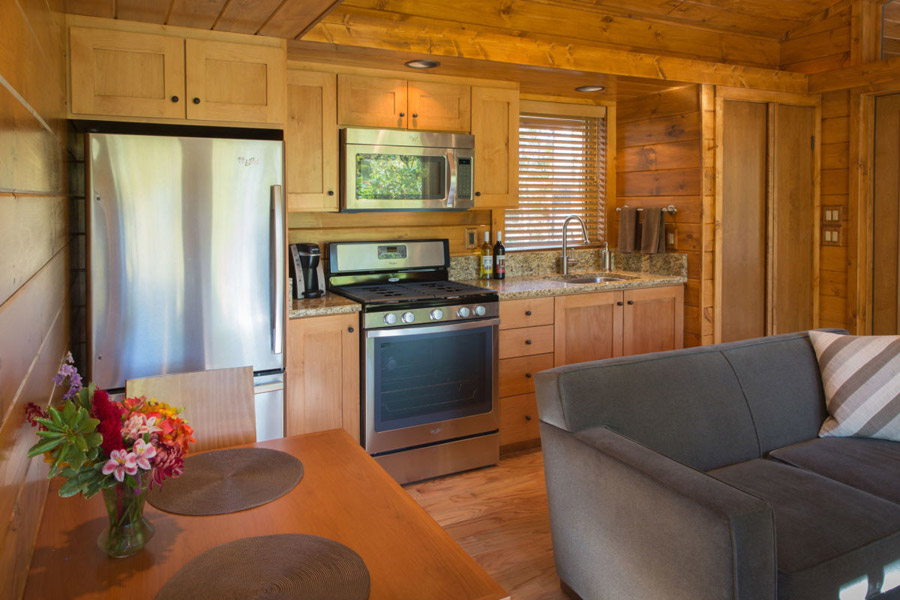
Not really related to my RV situation, but I thought of a design for a house like this a while back and then saw a live version of it:

http://tinyhouseswoon.com/escape-cabin/


I will have one someday.